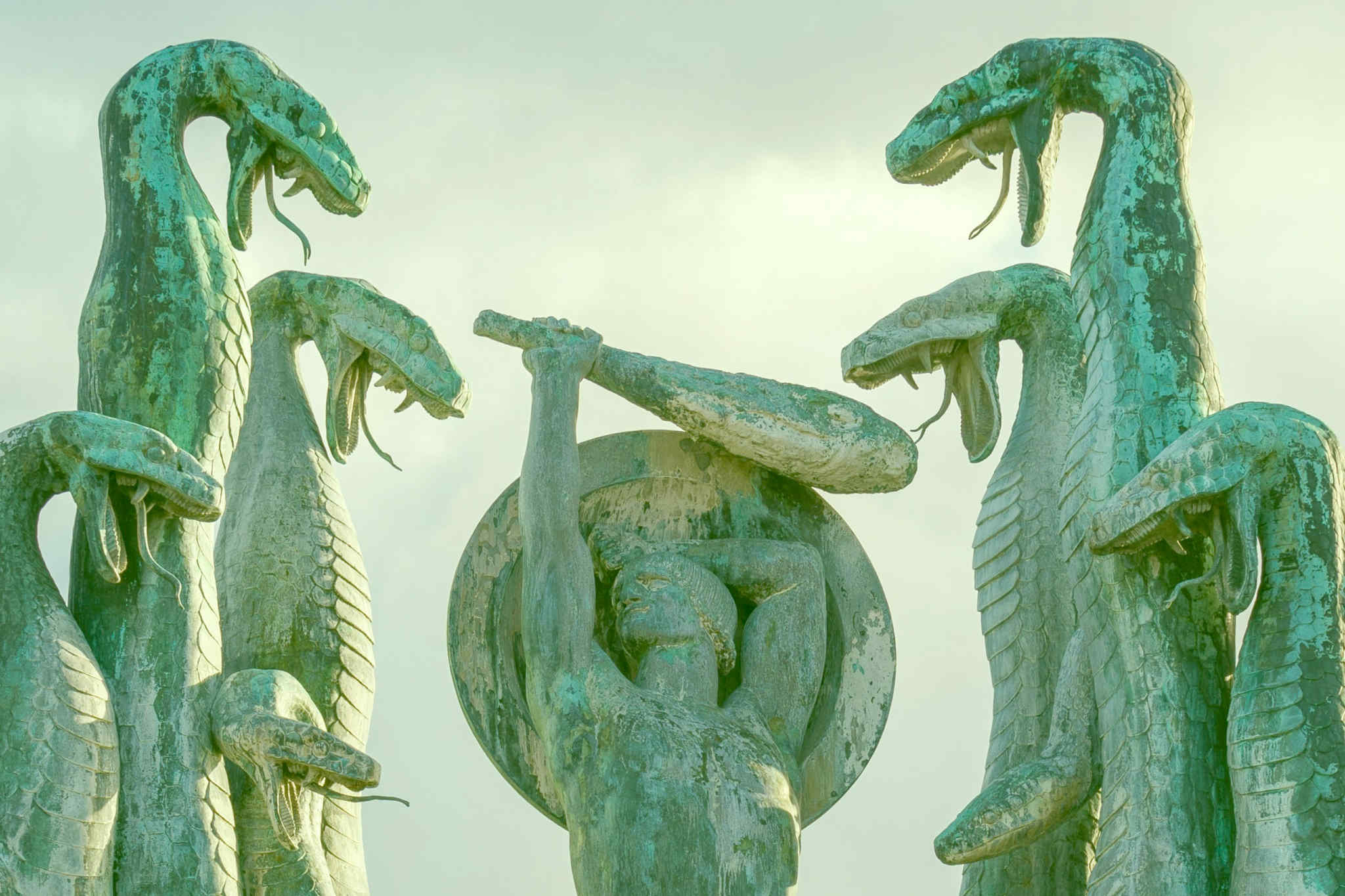
You might be one of those people who shudder and cringe at the thought of snakes. What is it that is so scary about these reptiles? Well, many things … one moment they’re there, physical; you can reach out and touch them (if you wanted to). But the next instant they have suddenly slipped away, disappeared. Then there is something about a snake’s sinuous movement, it coils and uncoils, tightens into itself then unwinds. A snake is secret, it moves unpredictably and fast. It has a sense of mystery. There is much magical, mystical symbolism in a snake.
Because a snake sheds its skin, this hints at the ability to regenerate itself … it emerges from a thin papery casing, brittle as dry leaves, leaving behind a vivid pulsing body, shiny and glistening and new. That speaks of immortality. Which is why every story about the origin of the universe has a snake at its centre. It is always the very first “water-spirit” … because water is where all life starts. From the ancient, primal formlessness of the ocean, the seed of life emerges.
Ancient Egypt
The Arabic word for ‘serpent’ is el-hayyah while their word for ‘life’ is el-hat (very close!). But more significantly, the el-hay part of serpent means ‘the life-giving’. In Ancient Egypt, the Book of Life describes how Atum was the very first living god ‘who came into being by himself’ when he rose out of the restless, seething primal ocean. The stories differ about how he then created the first gods, a god of air, Shu, and a god of moisture, Tefnut, using his body fluids (again, water).
Atum also turned into the new-born scarab-Sun rising in the East, which became the Sun-god Re at midday, finally reverting to Atum himself as a mature setting sun in the West. But most importantly, Sun-god Re’s headgear was always a giant disc encircled by a serpent.
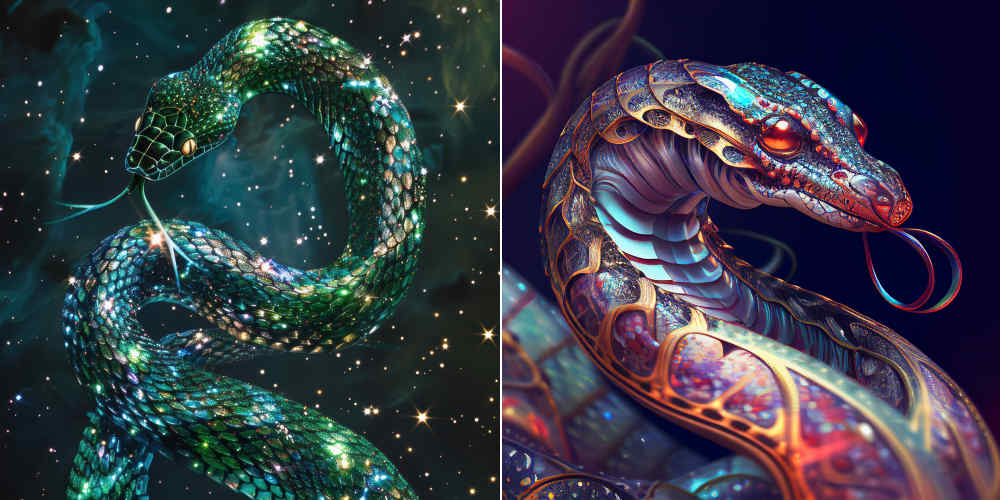
And then the pharaohs, and often the gods themselves, started wearing the uraeus at their brow, a cobra with a flared hood in mid-strike. It stood for knowledge, supreme power and control, life and youth. The temples belonging to the gods were carved with winged protector serpents; they were also painted on the walls of pharaohs’ tombs to accompany the kings on their Underworld journey.
The Celts
During Celtic times, when cryptic symbols known as runes were coming into being, slabs of rock known as runestones were often carved with the ouroboros, an unbroken circle of a snake biting its tail (it was actually inherited from Ancient Egypt). The circle was emblematic of self-renewal, the continuous process of life and death and rebirth. A circle also holds things together, prevents them from spilling outward. In Benin in West Africa, a country that has a rich folkloric culture, a famous disc exists of the Earth surrounded by an ouroboros.
Norway
The Tree of Life, Yggdrasil, in Norse folklore is encircled at its roots by a gigantic and fearsome serpent whose original home is the ocean. The Norse gods spoke of it as ‘older than the gods themselves’ and it was he who created the receding tides whenever he drank water, or massive storms when he was irritated or angry.
India
In Hindu mythology kundalini, powerful female energy, is symbolised by a serpent coiled at the base of the spine. When it is stimulated it ascends upward through each of the body’s seven chakras, awakening energy and the life force.
And then to bring us right into the 21st century, modern psychoanalysts believe that snakes (whether you have a sudden encounter with one, or it appears in a dream, or something similar) are a symbol of the deeper psyche, what is hidden in the lower levels of your consciousness, everything that is incomprehensible, unusual and mysterious.
Perhaps all this magical symbolism residing within a snake doesn’t make you feel so creepy and threatening now?