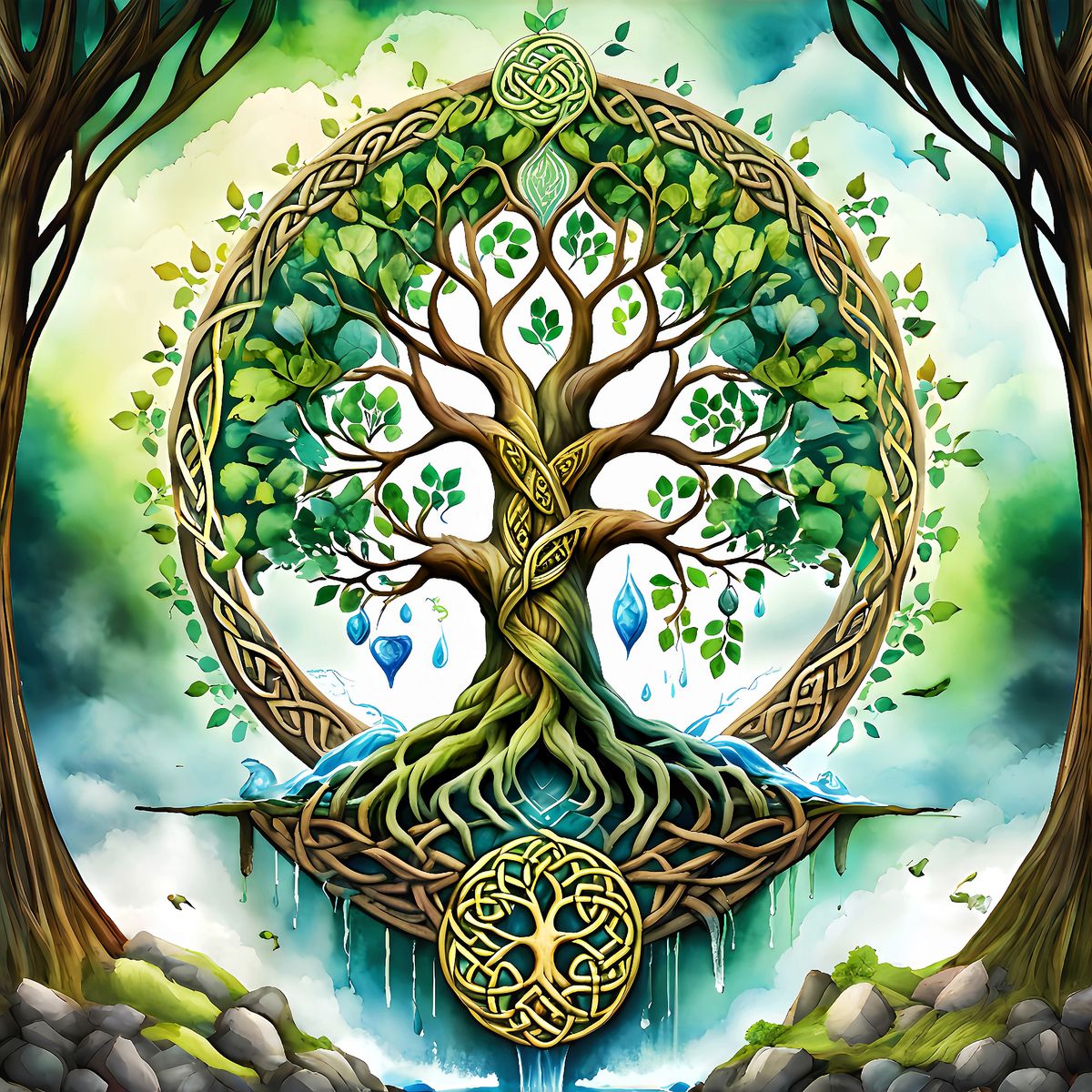
Tree of Life, World Tree or Cosmic Tree … most world mythologies have one. What is so magical about a tree? It connects the Earth with the Sky, the Underworld with the Cosmos, it reflects the cyclical nature of life . . . birth, decay, regeneration. It binds together the Five Elements: it is rooted in Earth, sap contains Water, there is Air in leaf-cells, Fire in twigs rubbed together, Spirit in the transpiration process.
Often a tree that is revered is evergreen. Its leaves never dry out, wither or die. This speaks of immortality. Leaves remain stubbornly green through the harshest frost-bitten winters. But not always. Sometimes a revered tree is deciduous, losing its leaves, shrinking to a skeletal outline in ice and snow. But then … sap rises, a tiny green shoot appears, the tree is reborn.
Norse Mythology
Yggdrasil is the ash tree that connects the Nine Worlds in which live dark and light dwarfs, frost giants, gods and goddesses, and humans. Yggdrasil’s roots are sustained by three wells: one in the misty icy realm of Niflheim; another, named the Well of Urd (or destiny) near the tree’s roots; and the third, named Mimir’s Well, in Jötunheim, realm of the giants. Living among the roots are the Norns, three sisters of Destiny who daily water the World Tree, drawing from the life-giving Well of Urd.
A fearsome dragon Nidhöggr lives beneath the tree’s roots. He spends his days gnawing away at them in an effort to bring down the entire cosmos … Yggdrasil is the sturdy backbone of all Nine Worlds.
Then there is the gargantuan sea serpent Jörmungandr who lives in the ocean; he is so massive he can encircle Yggdrasil’s trunk and still catch his tail in his mouth. An image that has become symbolic of Nature’s life-death-rebirth cycles. Circle of renewal after degeneration, spring following winter. He is often shown wrapped around the World Tree.
Yggdrasil is also the tree from which Odin hung upside-down for nine nights till he discovered the runes and gained enlightenment.
Hindu Culture
Like Odin, the Buddha’s tree was a giant fig, the Bodhi-tree, underneath which he sat for 49 days to gain his own wisdom. An inscription at Angkor Wat in Cambodia tells us that the Bodhi tree’s roots are Brahma (the Hindu Creator god), the trunk is Shiva (the Destroyer), and the branches Vishnu (the Preserver).
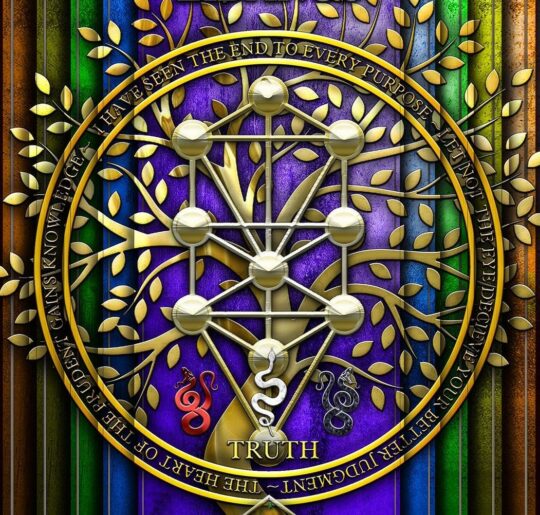
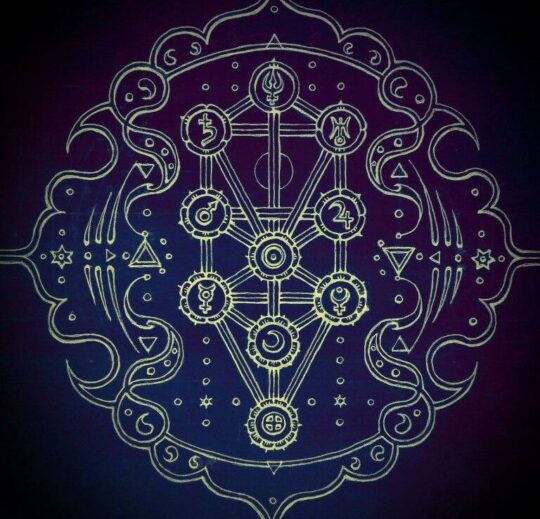
Two versions of the Tree of Life in Kabbalah
Kabbalah
The Tree of Life isn’t always a physical tree. In the Jewish mystic Kabbalah tradition, it is a complex diagram of interconnecting pathways, columns and coloured spheres. (The images above are not traditional as the spheres usually are represented in different colours. The image on the right features planetary glyphs.) A symbol of the structure of the universe, the Kabbalah tree of life also represents different aspects of the human psyche and the spiritual spark that is within all of us. The idea is that to follow the various paths, this will lead to personal transformation.
Chinese Mythology
In the Chinese mythological universe, earth and the underworld are linked by the World Tree Jianmu. Here the trunk rises straight up without branches to the cosmos, where it then spreads out its arms. Jianmu also serves as a ladder for the gods, bridging heaven and earth.
Native American Traditions
And finally, among the Pueblo Native Americans it’s the Pine Tree that’s revered; the wood gives them strong ladders to connect them with the cosmos. This ladder rises through a hole in the roof from the kiva, a circular ceremonial space underground, connecting the Pueblos with the sun. Symbolically mirroring this is a small hole in the floor of the kiva called a sipapu; this is where their ancestors emerged, they believe, from the Underworld.
So much magic in the humble tree!
Both Yggdrasil and the Kabbalah feature in my book Magical Number NINE (click here)