My Inspiration

Mythology … fantasy … magical realism

Why do I love mythology? And … how does mythology differ from pure fantasy?

Well … both, certainly, involve a wonderfully creative imagination. But let’s look a little closer. Fantasy is full-on enchantment … fairies, witches, wizards, demons, dragons … figments of an inventive mind. Mythology, on the other hand, is firmly tethered to a physical, real world. Mythology is any real-life cultural group’s way of trying to make sense of life around them. Fertile creative minds fabricating stories that try to explain the unexplainable. So … mythological monsters, for example, are the physical manifestation of a cultural group’s fears; whereas the happy light-filled characters give a people’s hopes and aspirations physical shape and form.

Slowly the identity of a people becomes defined by these invented monsters and gods and sly characters, all of whom help to ground them in an often confusing world. And here’s an interesting fact. All mythological tales, from whatever culture they emerge out of, make sure to invest their gods (and goddesses) and other main characters with a sombre, dark side. Just consider: the Creation stories of all indigenous or aboriginal peoples … Native American-Indians of North America, the Sámi of Norse or Scandinavian tradition, Ancient Egyptians, Aboriginals of Australia and New Zealand, KhoeKhoen herders and the hunter-gatherer Bushmen of Southern Africa … they all have mythic characters possessing both negative and positive personality traits.

Why? Because they all know that being human involves frailties and weakness; always, somewhere, an underlying malicious streak exists. They recognise that where there is good, there is also evil. It is uncontested. SO … Mythology is the world view of real people living and breathing and existing in a tangible physical world. BUT it is also steeped in magical realism, fantasy and imagination. That’s why I love it.
Norse Mythology

Norse mythology, the tales and folklore of all the countries of Scandinavia, is centred on a massive world tree, Yggdrasil. This tree of life soars into the sky across nine worlds, inhabited by gods and goddesses, frost giants, light and dark dwarfs and, of course, humans.

The many characters of this mythology are loud and rambunctious, mischievous and serious, beautiful and whiskered and hairy. Most famous among them is the father of all gods, wild and long-haired Odin, thundergod Thor, trickster Loki, the radiant golden-haired Freya and her brother Freyr.

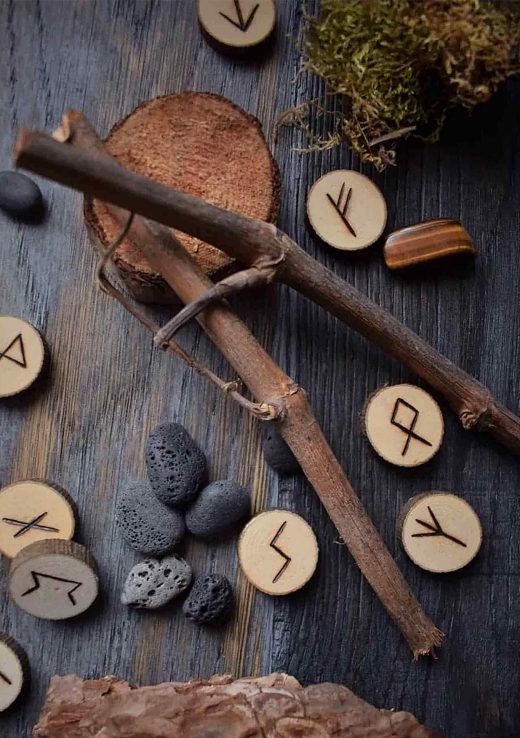
Peculiar to the Nordic gods and giants is the way they exhibit human foibles and strengths such as love and betrayal, rivalry and courage, fickleness and treachery. The Norse gods also devised a complex system of communication, the runes, small symbols composed of lines and angles carved onto wood and stone. Encoded within these glyphs is much deep meaning and symbolism and many are used for protection against evil energies.

For those residing in the nine worlds, most of their life is spent trying to prevent Ragnarök, the calamitous end of the world. Theirs is a world of destiny, of heroism and honour, of courageous fighting in battle.

Norse Mythology

Egyptian Mythology

The mythology of Ancient Egypt, which is imbued with deep, insightful knowledge and a marvellous sophistication in architecture and temple paintings, is one of the most complex of all world mythologies.

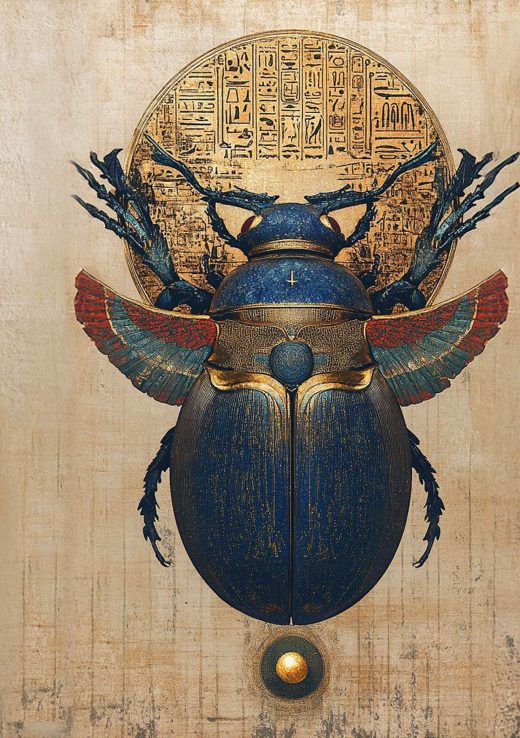
The grandeur of the Great Sphinx, the Pyramids, the elaborate monuments and temples, reveals a startling complexity in building techniques. And the painstakingly executed, vivid paintings on temple and tomb walls show a refined artistry, while their hieroglyphics present an intricate pictorial system of writing. The Egyptians living alongside the Nile as they did, their existence was closely associated with the river’s seasonal cycles and its annual flooding, so their gods and goddesses are symbolic of water, fertility, the sun and the rain.

The gods also present unusual guises as animal manifestations … falcon-headed Sun god Re, jackal-headed Anubis, wise Thoth with his ibis head, Set with his anteater snout. And with the constancy of harvest cycles followed by crop regeneration, the Ancient Egyptians had deep in their psyche a fascination for the circle of death and rebirth in their own lives.

They firmly believed in the dark and mysterious Underworld through which deceased pharaohs had to battle with fearsome monsters to earn their right to Osiris’s Underworld kingdom of eternal life.

Egyptian Mythology

San Bushmen

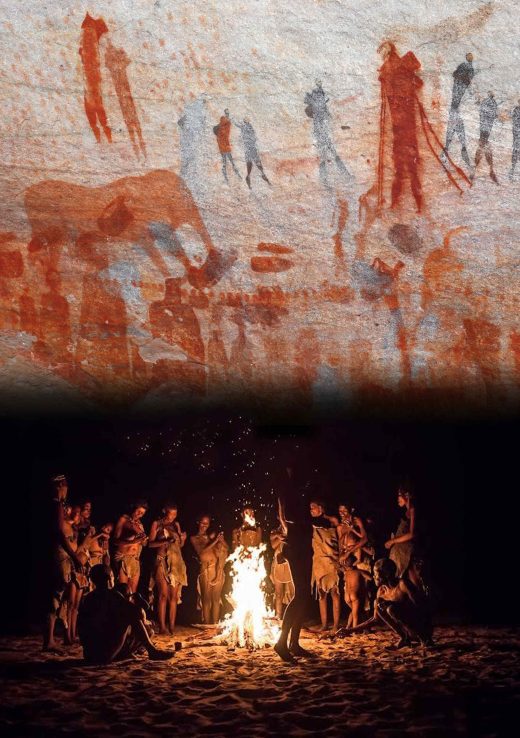
What marks the San people of Southern Africa is their deep belief in animism … that trees, plants and rocks as well as animals and all living things possess spirit. Even the sun and the stars hold their own palpable energy, and this commands the San’s greatest respect.

It is important for them to live in harmony with their environment, to achieve a balance between the positive and negative forces around them. Their knowledge of medicinal plants and herbs is extensive, and they apply this to natural healing and to ward off evil spirits.

The San creator god is a praying mantis, /Kaggen, but in the pantheon of gods are also a mongoose, a dassie, and a porcupine, among others. The San place great importance on their connection to the spirit world and /Kaggen serves as a mediator between that and the human world. The San particularly revere the eland, whose spirit appears to them in trance and whose energies they enlist before they hunt.

Shamans engage in chanting and perform trance dances to ease communication with their ancestors. In their rock paintings, created out of ochre, blood, egg white, plant sap, ash, and even animal droppings, they depict the animals they encounter. They reveal too their trance transformations into eland, thus creating a bridge between the San and the spirit world.

San Bushmen Mythology
© Myth Oracle 2026 Designed and hosted by S² Web Solutions