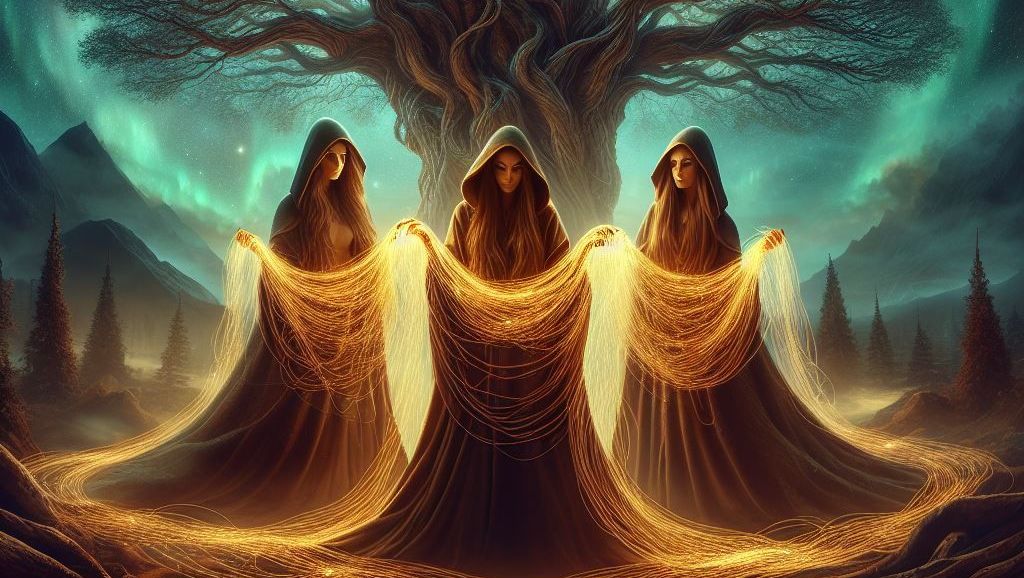
Mysterious women who hold up mirrors to reflect a person’s past or future. Who unravel thread to wind it onto a spindle for future weaving. Who carve exotic shapes of runes into the bark of Yggdrasil, the mighty world ash-tree. They are Fates, Norns and Weavers of Destiny.
These ladies, obscured by veils and mists, appear in many, many different cultures around the world. From Scandinavia in the far north to England and Ireland, from Albania, Greece and Eastern Europe to Lithuania and India.
They go by many names . . . Moirai, Parcae, Nornir, Fates.
What they all have in common is the power (and the responsibility) to weave the destiny of individuals’ lives, both among gods and humans. Most commonly they are three sisters, each one responsible for a specific aspect of life: past, present, and future. In Celtic mythology, they appear as seven sisters, as they do also in Lithuanian folklore. These Fates were a way ancient civilisations felt they could control the intangible laws of the universe, to make sense of what wasn’t easily explained.
Nordic
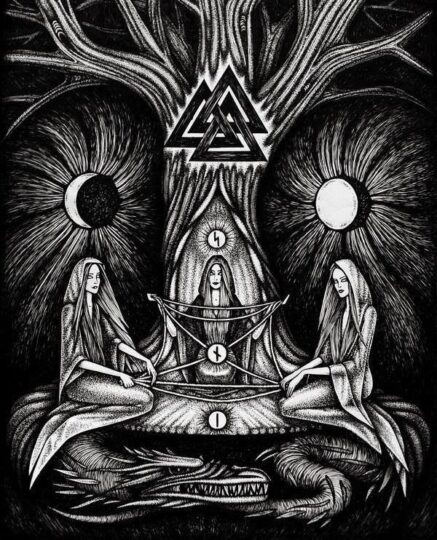
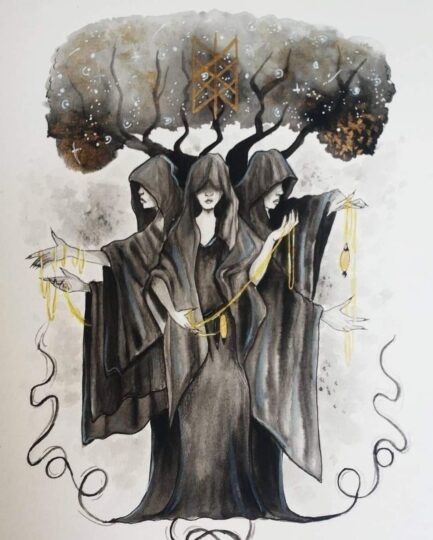
In the Norse beliefs of Scandinavia, the inevitable, inescapable fate of all gods and humans was known as wyrd. The names of the three Norn sisters clearly reflect each one’s task: Urd means ‘past’, Verdandi means ‘becoming’ or ‘present’, Skuld means ‘that which is intended’ or is ‘upcoming’. The sisters live among the roots of the Tree of Life; here they also ensure it is regularly watered from the Well of Urd, an underground spring close by. The Norns are often depicted spinning and weaving the threads of destiny. When they carve runes into Yggdrasil’s trunk, the symbols’ intentions are drawn up through the tree, influencing all of the Nine Worlds.
Greeks and Romans
Among the Ancient Greeks, the Moirai meant ‘Apportioners’, describing their role of allocating destinies. The sisters were named Spinner, Apportioner, Inflexible. Of the Roman Parcae sisters, Nona spun the thread of life onto her spindle, Decima measured the thread to determine how long the life of the individual would be, Morta finally cut the life thread.
Lithuanians
Definitely, my favourite of all the stories is this Lithuanian folktale. A person’s fate was spun at birth by seven goddesses known as the deives valdytojos. This was hung as a star in the sky. When that person died, the thread snapped and the star fell as a meteor.
Too beautiful for words … and also closely reminiscent of the San Bushman belief that when a person dies, it is reflected as a falling star.
The Norns appear in my Norse mythology-fantasy story Magical Number NINE (click here)