
Most people identify the caduceus (aside of, naturally, as a medical symbol) with the Roman god Mercury (originally, Hermes the Greek god). He is always depicted holding his tall winged staff wound about with a pair of snakes.
Origins
In reality, the caduceus is an ancient symbol, first appearing in Hindu and Mesopotamian cultures as far back as 4000 to 3000 BCE! Mesopotamia ― think Sumerians, Babylonians, Assyrians ― is seen as the cradle of civilisation. A Sumerian goblet, dating to 2600 BCE, was discovered engraved with a staff with two snakes wound around it; in India during a similar period this symbol was punched into coins. At this time, the central post of the caduceus reflected the sacredly held Cosmic Tree. The snakes symbolised a Sumerian god of the Underworld, who was also messenger to the ‘Earth mother’. Clearly shades of the later god Hermes / Mercury who came to represent the messenger and communicator.
So how did it evolve?
Hermes & Mercury
The Greek god Hermes was a mediator between two worlds, helping souls navigate the transition between life and death in the Underworld. His winged feet made him swift, aiding his travel backward and forward to and from the Afterlife. Hermes was first given the staff by his half-brother Apollo after he’d received Hermes’s lyre as a gift because he loved the sweet music it produced. The Greeks added wings above the serpents’ heads on the staff to symbolise a soul’s spiritual journey to the Underworld.
As Hermes and, later, the Roman god Mercury navigated the Underworld, they strengthened their role of communicator and news-bringer for those back on Earth. The word caduceus is a Latin modification of the Greek term for ‘herald’s staff’ ― alluding of course to their communicating role. The gods developed perception and insight, eloquence, sharpness of wit. Their tongues became slippery as quicksilver. And just for fun, they developed a sly mischievousness.
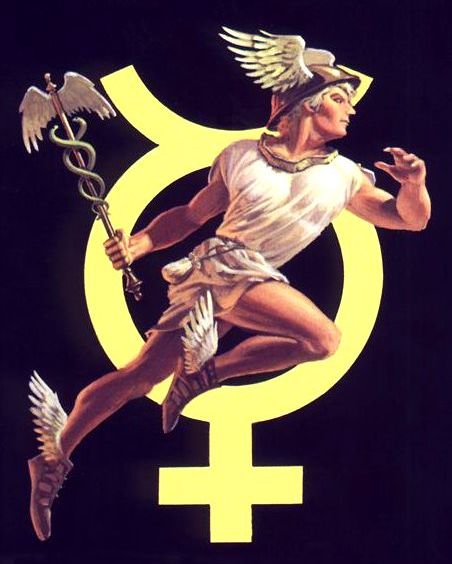
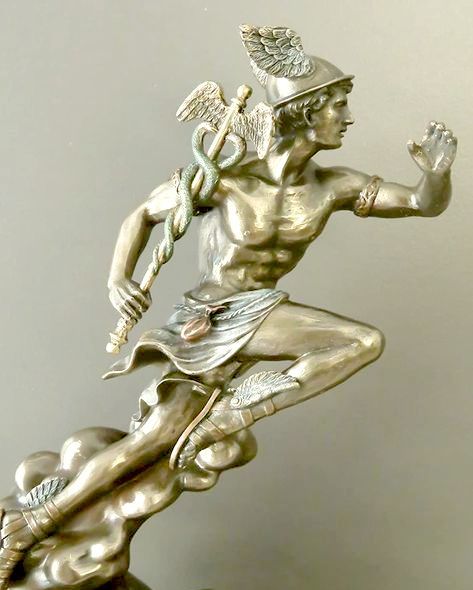
Some of the ancient symbols for today’s caduceus depicted the two snakes at the top of the staff making a wide circular loop as their heads turned back towards each other to cross, and then curve inward, looking a little like horns. If you look at the glyph for the astrological sign for Mercury ☿, you’ll see the idea of the loop and the horns; in addition, a crossbar was added to the staff (see above left). Fascinating!
Symbolism today
From a psychological view, the two serpents winding in opposite directions around the central staff ― the world axis ― represent a balance of opposites: left and right, light and dark, danger and healing. When seen as two fighting serpents they represent original chaos, and point to our need to balance our naturally opposing human tendencies. They symbolise human complexity and the constant potential for self-development.
The two winding serpents are seen by some to be in a sexual embrace, circling the ‘phallus’ of the pillar. In this respect they are a fertility symbol. Healing happens when the male and female aspects of our psyche become integrated.
Finally, as a modern medical symbol, the caduceus’s origins lie with Asclepios, son of Apollo. As Greek god of medicine he used poisons to cure disease and bring the dead back to life (much like today’s homeopathy which believes that ‘like cures like’ ― giving a person a minuscule amount of what ails them to stimulate the body’s natural healing response). Asclepios’s staff, though, had only a single snake winding around it. This is in fact the more accurate symbol for the medical world.
Astronomy
From earliest civilisation, planets were named after the gods. So when it was the Greeks’ and Romans’ turn, they observed that (the as-yet-unnamed) planet was the fastest-moving of the known planets around the Sun. As the closest to the Sun, it completes its orbit in 88 days. It seemed quite natural, then, to name it after the speedy messenger of the gods.
And then, much later, when a fast-flowing, malleable, liquid metal was discovered, its original name of quicksilver became mercury.
Who would have thought that one term could embody such diverse symbolism?